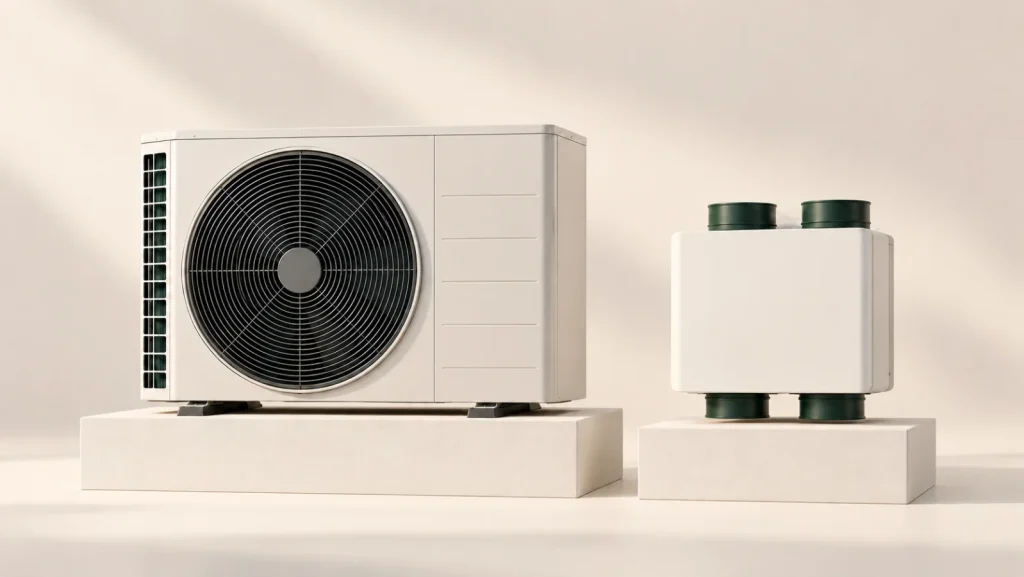
When we ask clients for their heating and ventilation specification, we often receive something like “Heating: ASHP. Ventilation: MVHR.”
That tells us what type of systems they’re planning, but very little about the equipment itself. We can run a SAP calculation using generic information. The problem is that the result may look different once we know exactly which products will be installed.
If your design is struggling to pass, it’s worth checking those details before spending money on extra insulation or solar panels.
ASHP and MVHR are descriptions, not specifications
Two air source heat pumps can have different efficiencies. Two MVHR units can recover different amounts of heat and use different amounts of electricity to move the air. Simply selecting the system type does not capture those differences.
SAP has a Product Characteristics Database containing performance data for specific equipment. Where suitable product data is available, we can use the relevant entry rather than relying on generic assumptions.
The make and model are the starting point. We also need to make sure the entry and installation details match your proposal. Picking the best looking efficiency figure from a brochure isn’t the same as modelling the system correctly.
To make a fair comparison, we used the same building fabric throughout, matching the notional dwelling specification, with air permeability set at 5 m³/(h·m²) at 50 Pa. Its fabric energy efficiency exactly met the target in every run. We then changed the heating, hot water and ventilation selections to see how they affected the results.
What difference does the heat pump make?
An air source heat pump uses electricity to provide heat. Its efficiency affects the energy SAP calculates the home will need for heating and, where applicable, hot water.
If your installer has already selected a heat pump, give your assessor the exact model. That lets us check the appropriate product data and the proposed system, rather than treating it as an unspecified ASHP.
For this comparison we used a Vaillant aroTHERM plus 5 kW heat pump paired with a Vaillant uniTOWER hot water cylinder. The generic heat pump was paired with a generic cylinder, so this compares the heating and hot water package, rather than the heat pump alone.
Keeping generic MVHR in the calculation, the specified heat pump and cylinder reduced the dwelling primary energy rate (DPER) from 78.69 to 67.49 kWh/m² per year. That is an improvement of around 14%, but it still exceeded its target of 55.90. Identifying this package helped, but did not resolve the primary energy failure on its own.
What difference does the MVHR make?
Mechanical ventilation with heat recovery uses heat from the outgoing air to warm the incoming fresh air. Its fans also use electricity. SAP accounts for both, so the unit’s heat recovery performance and fan power matter.
A generic MVHR selection cannot describe every unit on the market. The specific product data helps us represent the system you actually intend to install.
We selected a Nuaire MRXBOXAB-ECO3B with five wet rooms. Keeping the generic heat pump and cylinder, this reduced DPER from 78.69 to 56.33 kWh/m² per year, an improvement of around 28%. That put it close to the 56.05 target, but still just above it.
What happens when we specify both?
With both the Nuaire MVHR and Vaillant heat pump/cylinder package selected, DPER fell to 44.91 kWh/m² per year against a target of 55.90. The primary energy result now passed, coming in around 20% below the target. Compared with the generic combination, calculated primary energy use was around 43% lower.
| Ventilation | Heating and hot water | DPER | Target (TPER) | Primary energy check |
|---|---|---|---|---|
| Generic MVHR | Generic heat pump and cylinder | 78.69 | 56.05 | Fail |
| Generic MVHR | Vaillant heat pump and uniTOWER | 67.49 | 55.90 | Fail |
| Nuaire MVHR | Generic heat pump and cylinder | 56.33 | 56.05 | Fail |
| Nuaire MVHR | Vaillant heat pump and uniTOWER | 44.91 | 55.90 | Pass |
| No MVHR | Generic heat pump and cylinder | 56.61 | 56.05 | Fail |
| No MVHR | Vaillant heat pump and uniTOWER | 45.30 | 55.90 | Pass |
The dwelling emission rate (DER) was below its target in all six runs, ranging from 7.41 to 4.27 kg CO₂/m² per year. Dwelling fabric energy efficiency (DFEE) stayed at 39.56 kWh/m² per year, equal to its target in every run. The issue exposed by the generic selections here was primary energy, not a fabric shortfall.
We also ran the assessment without MVHR. With the specified Vaillant package, DPER was 45.30, compared with 44.91 using the Nuaire MVHR. With the generic heat pump and cylinder, the corresponding figures were 56.61 and 56.33. The generic MVHR runs performed considerably worse in this example. That is a reason to check the product data, not a reason to assume every MVHR system makes a design better or worse.
These figures describe calculated performance in this assessment, not measured energy use or a forecast of the household bills. The target also changed slightly when the heating and cylinder package changed; the table keeps that difference visible.
The useful question is whether the design needs changing, or whether the assessment needs better information. Identifying equipment already in your specification doesn’t mean you’ve upgraded the building. Choosing a different product to improve the result does.
Specific products are not an automatic pass
The actual product data may improve the result, make little difference or reveal that the original assumptions were too optimistic. Either way, you have a better basis for deciding what to do next.
A more efficient heating system also does not resolve every type of SAP failure. If the problem is the fabric energy efficiency result, you need to look at the building itself. Our guide to fabric energy efficiency explains that distinction.
What should you send your SAP assessor?
You don’t need to interpret the product database yourself. Send us:
- The heat pump manufacturer and exact model, including the proposed indoor and outdoor units where relevant.
- The MVHR manufacturer and exact model.
- Your installer’s quotation or system specification, if available. Product links and technical sheets are useful too.
If you haven’t chosen the equipment yet, tell us. We can explain which assumptions we’re using and which details need confirming as the design develops.
Our new build SAP service includes advice and reasonable revisions. We check the specification and help you understand which details are affecting the result. If you would like us to assess your project, send us your plans for a quote.